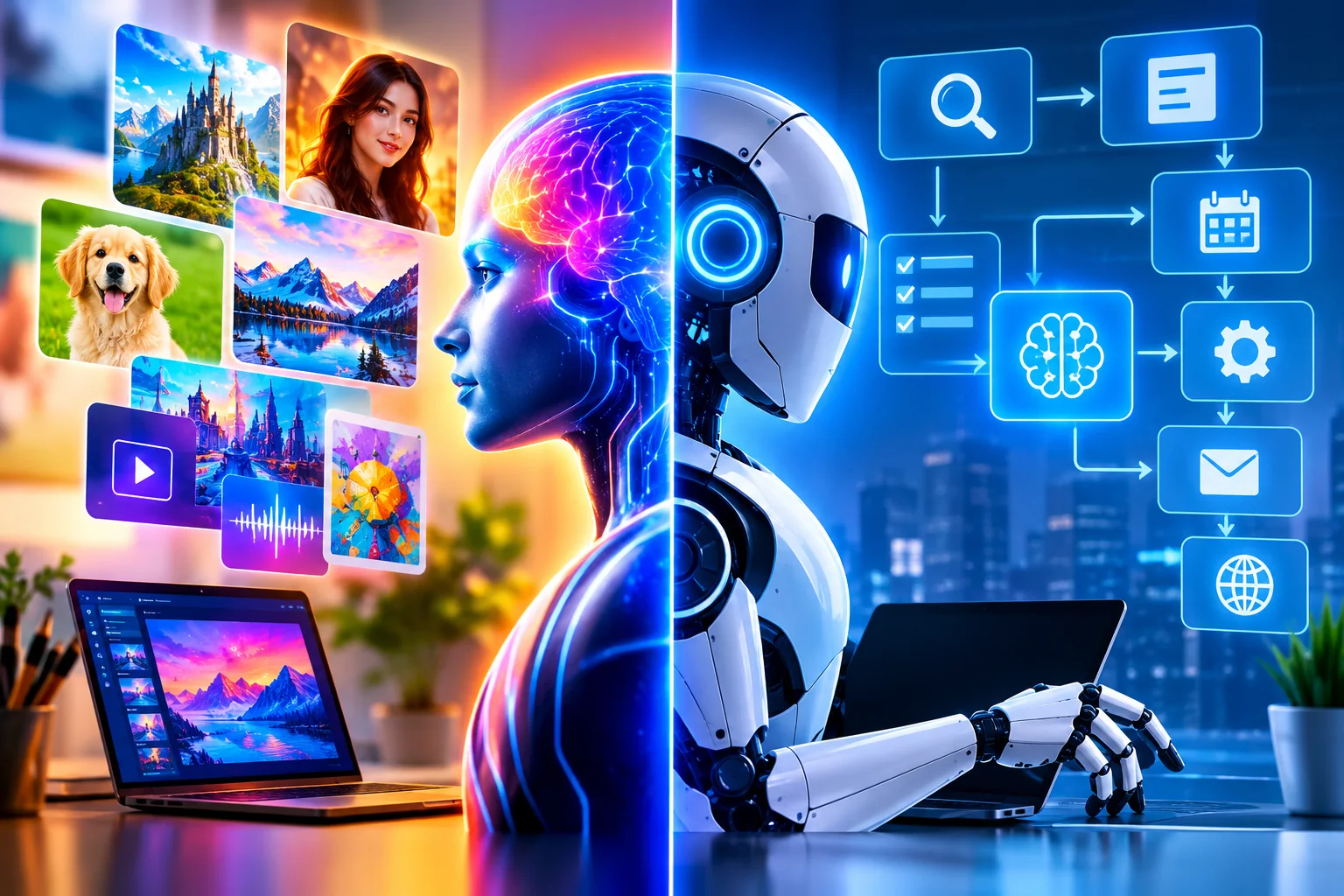
The world of AI has changed very fast over the last few years. First came ChatGPT, then tools like Gemini and Claude, and now everyone is talking about “AI Agents” and “Agentic AI.” Are Generative AI and Agentic AI the same thing? Is ChatGPT an AI Agent? What should engineering and IT students learn first?
In this article we will answer these questions in plain language. We will also look at the steps that matter most if you want to move ahead in this field.
- Generative AI creates new content; Agentic AI plans and acts to reach a goal.
- They are not rivals: Agentic systems often run on top of Generative models.
- Learning order: basics, Generative AI, Python, APIs, frameworks, then Agentic AI.
What Is Artificial Intelligence?
Artificial Intelligence, or AI, means building computer systems that can learn like humans, understand things and help make decisions. In simple words, it is about preparing a computer so that it learns from data, understands the situation and suggests the right path based on it.
AI is not a single technology. It is a group of many branches:
- Machine Learning: the system learns patterns from data.
- Deep Learning: learning complex patterns with the help of Neural Networks.
- NLP (Natural Language Processing): computers understand human language and respond to it.
- Speech Recognition: systems like Siri and Alexa recognise our voice.
- Computer Vision: computers identify objects in images and videos.
- Robotics: machines and robots work with the help of instructions or AI, as in factories.
Three basic abilities sit behind all of these: Reasoning, Learning from experience, and Perception, which means understanding the surroundings through inputs like a camera or voice.
The 5 Layers of AI: Why Agentic AI Sits at the Top
The easiest way to understand this is to see AI as five layers, where each layer is built on top of the one before it.
- Artificial Intelligence: the widest umbrella, meaning machines that do intelligent work.
- Machine Learning: machines learn from data. Algorithms such as Linear Regression, Logistic Regression, Decision Trees and SVM belong here. Many of them rest on Statistics, so a basic understanding of Statistics helps before you start ML.
- Deep Learning: an approach based on Neural Networks. Models such as ANN, CNN, RNN, LSTM, GRU and Encoder-Decoder come under it.
- Generative AI: models that create new content, such as Large Language Models (LLMs). The Transformer Architecture is behind today’s LLMs.
- Agentic AI: systems built on top of LLMs that plan for a goal, use tools and work across many steps.
Agentic AI is not some separate magic. It is the next step standing on the foundation of Generative AI. That is why learning Agentic AI becomes hard without a basic understanding of LLMs.
What Is Generative AI
The main job of Generative AI is to create new content. It can produce text, images, video, music, code, presentations, voice and designs. Say “write me a Java program” and it will write the code. Say “make a PowerPoint” and it will prepare the slides.
Some popular tools:
- ChatGPT: help with writing, answering questions and coding.
- Google Gemini: for understanding information, writing and analysis.
- Claude: for writing, analysing documents and coding.
- Microsoft Copilot: AI help inside Word, Excel and PowerPoint.
- DeepSeek: for reasoning, coding and technical work.
- Midjourney: AI-made images and artistic designs.
- Canva AI: posters, designs and presentations.
Generative AI saves time and speeds up creative work, which is why its use has grown so quickly. But it also has a limit. It mostly responds according to the user’s instructions. To complete a complex task on its own, it needs separate tools, permissions and the right workflow.
Take an example. You say, “Book my flight.” Generative AI will find options, compare them and explain the booking process. But the actual booking, payment or notification will happen only if the related services are connected and you have given the required permission. This is where the story of Agentic AI begins.
What Is Agentic AI?
Generative AI creates content, while Agentic AI plans, makes decisions and also takes action to reach a set goal. Roughly speaking, Generative AI gives you an answer, and Agentic AI uses the available tools and permissions to try to carry that answer forward into actual work.
The difference in one line:
Generative AI says: “Here is your answer.”
Agentic AI says: “I will try to get your work done with the tools available.”
Agentic AI is neither fully independent nor always right. It needs proper instructions, safety rules, permissions and, when required, human oversight.
An Example: A Technical Event at College
Suppose a student wants to organise a technical event at their college.
Generative AI will help prepare the schedule, draft the budget, write invitation letters and suggest new ideas. In other words, planning and content are its part of the job.
Agentic AI, given the right tools and permissions, can make a task list, help assign responsibilities to volunteers, send emails, update the registration records, keep an eye on responses and finally prepare a report as well.
From Prompt to Action: How Does AI Work?
In Generative AI you give a prompt, the LLM processes it and returns an output. The matter ends there.
In Agentic AI a goal is set first, and then the system goes through several steps:
- Thinking: understanding the problem and the available information.
- Planning: making a plan to complete the task.
- Tool Calling: using external tools as needed.
- Observation: looking at the results the tools return.
- Adaptation: changing the next step based on those results.
- Final Output: presenting the result at the end.
This is a common framework. In real systems, the order and structure of the steps can differ.
Generative AI vs Agentic AI: 6 Big Differences
| Aspect | Generative AI | Agentic AI |
|---|---|---|
| Purpose | Create new content | Reach a set goal |
| How it works | Usually responds to the user’s prompt | Plans and works across multiple steps |
| Use of tools | Limited, must be connected separately | A core part of the work |
| Monitoring | Almost none | Tracks progress and can change the plan |
| Example | Getting an email or code written | Writing code, running tests and checking errors while building an app |
| Uses | Writing, coding, translation, summaries, design | Customer support, business automation, research, personal assistants |
Demand and Careers in Agentic AI
Many companies today want to make their work more efficient with the help of AI. Their focus is on automating work, building AI Copilot systems, cutting costs and finishing work faster.
With Generative AI, companies can create content and answer questions. With Agentic AI, they can build systems that handle multi-step work. For example, an AI Agent can understand a customer’s problem, find the relevant documents, prepare a reply based on them and, if needed, pass the case to a human employee. However, all of this depends on the system’s capability, tools, permissions and safety arrangements. To see the bigger picture of a career in AI, read our AI Engineer Roadmap.
AI Learning Roadmap
Step 1: Where Should You Start Learning AI?
First understand these: what AI is, what Machine Learning is, what Deep Learning is, what an LLM is, and how tools like ChatGPT prepare their answers. Once the foundation is strong, everything after it feels easier. If you are interested in ML, build a basic understanding of Statistics too.
Step 2: Generative AI
First learn Prompt Engineering, which means giving AI clear and detailed instructions. See the difference. Instead of just writing “Help me learn Python,” write: “I am a beginner student. Explain Python loops in simple language and show me programs with three examples.” The second way gets a much better result.
Then practise these tasks: getting text written, generating images, writing and debugging code, summarising documents, translating and preparing study notes. You can try ChatGPT, Gemini, Claude, Microsoft Copilot, Canva AI and GitHub Copilot. Every tool has its own strength, so using them yourself is the best way to learn.
Step 3: Programming
If you want to become an AI developer, Programming is a must, and Python is one of the most popular languages in this field. Pay attention to these:
- Variables, Data Types, Loops, Functions and Conditions
- OOP: Classes, Objects, Inheritance and Polymorphism
- DSA: Arrays, Linked Lists, Searching and Sorting
- File Handling: reading and changing CSV and text files
- Exception Handling: handling errors properly
After that, learn Pandas, and later libraries like TensorFlow will come in handy. If you want to work with data, you can also look at our Data Analyst Roadmap and the SQL Course.
Step 4: API Integration
API stands for Application Programming Interface, and it works as a bridge between two pieces of software. Suppose a user types a question on your website. Your site sends that question to an AI service through an API, the service prepares the answer, and the same answer comes back through the API to your site and appears on the user’s screen.
You can read about the OpenAI API, Google’s AI services, Hugging Face and Azure AI. In the beginning you don’t need to build a model from scratch. Connecting ready-made models through an API is enough. Just keep in mind that every API has different rules, features and costs.
Step 5: AI Frameworks
Frameworks make it easier to build large AI applications:
- LangChain: for LLM-based apps and tool integration.
- LangGraph: for workflows with many steps and decisions.
- LlamaIndex: for connecting LLMs with documents and data sources.
- Microsoft Semantic Kernel: for combining AI models with software functions.
You don’t need to learn them all at once. Pick one and practise by building a small project with it.
Step 6: Agentic AI
When you have a good grip on Generative AI, Python, APIs and Frameworks, start Agentic AI. Here the goal is not just producing answers but learning to build systems that work across many steps toward a goal. Keep your focus on these topics:
- Task Planning
- Tool Calling
- Workflow Automation
- Memory and Context Management
- Error Handling
- Human Approval and Safety Controls
- Multi-step Workflows
For study, you can look at trusted platforms like DeepLearning.AI and Coursera. Before spending money on any certificate programme, always check its current syllabus, fees and recognition.
Step 7: Build Real Projects
Building projects with your own hands is a must. Beginner projects: AI Resume Builder, AI Study Assistant, Notes Summarizer, AI Question Answering Tool.
Slightly bigger projects: AI Research Assistant, Email Automation System, Customer Support Chatbot, AI Coding Assistant, Meeting Scheduler, Travel Planner, Personal Finance Assistant.
For example, in an AI Study Assistant the student uploads their notes and the AI prepares summaries, questions and answers from them. Projects like these give you real experience with APIs, data handling, frameworks and security.
Step 8: Take Your Project Online (Cloud Deployment)
- Git and GitHub: to keep a record of your code and share it with others.
- Docker: to package an application together with its requirements.
- FastAPI: to build APIs with Python.
- Streamlit: to build simple interactive web apps.
- AWS, Azure and Google Cloud: for hosting on the cloud.
Do put your GitHub link on your resume so companies can see your real work. You can also try our Resume Builder to create one.
What Skills Are Companies Looking For?
- Prompt Engineering: writing clear and effective instructions.
- Python Programming: for building AI apps and processing data.
- API Integration: connecting AI models and outside services to software.
- AI Automation: automating repetitive tasks.
- LLM Application Development: building applications based on LLMs.
- RAG (Retrieval-Augmented Generation): improving AI answers by pulling information from outside documents or data.
- Vector Databases: understanding systems that find related information through embeddings and similarity search.
- Cloud Deployment: running and managing an AI app online.
- Git and GitHub: version control and the ability to work in a team.
Frequently Asked Questions (FAQ)
Is ChatGPT an AI Agent?
ChatGPT is basically a Generative AI tool. When it is connected to tools, permissions and workflows, it can become part of Agentic processes.
Should I learn Generative AI or Agentic AI first?
First the basics of Generative AI and LLMs, because Agentic AI is built on top of them.
Do I need to know Python to learn Agentic AI?
If you want to work as a developer, yes. Python is the most widely used language in this field.
Should Agentic AI be used for every problem?
No. Where a simple LLM call or program can do the job, there is no need for Agents.
Can Agentic AI work completely on its own?
No. It needs proper instructions, safety rules, permissions and human oversight as required.
Conclusion
Generative AI creates new content, while Agentic AI plans for a set goal and moves the work forward. The two are not opposed to each other, but two steps on the same ladder.
The learning order is simple: first the basics of AI and Generative AI, then Python, APIs and Frameworks, and after that Agentic AI and real projects. Knowing the names of tools is not enough. The real value lies in how you use them to solve real-life problems.
Disclaimer: This article is for educational purposes only. Tools, courses and job demand change over time, so please check the latest information before making any decision.